I am an assistant professor of biostatistics at the Harvard Chan School of Public Health, where I lead a statistical science research group—the NSH Lab (pronounced like “niche”)—focused on developing novel theory, methods, algorithms, and open-source software for causal inference, causal machine learning, and semi-parametric estimation; assumption-lean and non-parametric inference; statistical machine learning; and computational statistics. My statistical methods research is strongly motivated by questions arising from my collaborative research in applied biomedical and health contexts. Areas of focus include the infectious disease sciences, the epidemiology of chronic diseases and of cancer, and implementation science. I am also a faculty member within the Harvard–MIT Program in Health Sciences and Technology and the Dana-Farber/Harvard Cancer Center, an associate member of the Broad Institute of MIT and Harvard, and a faculty affiliate of both the Institute for Quantitative Social Science and the Harvard Data Science Initiative.
Prior to joining the faculty in the Department of Biostatistics at the Harvard Chan School in 2022, I held an NSF mathematical sciences postdoctoral research fellowship, through which I worked with Iván Díaz and Peter Gilbert, developing new techniques for causal mediation analysis while serving as a core member of the COVID-19 Prevention Network’s (CoVPN) biostatistics response team. To CoVPN I contributed statistical methods innovations and the design and implementation of open-source software tools for the evaluation of candidate immune correlates of vaccine protection. In 2021, I obtained my PhD in biostatistics from UC Berkeley, under the supervision of Mark van der Laan and Alan Hubbard. During that period, I worked on topics in statistical and causal inference, and I co-created the TLverse project, an open-source software ecosystem for targeted machine learning. Before that, I spent my undergraduate years in beautiful Berkeley, California—go bears.
John Tukey once famously remarked, “the best thing about being a statistician is that you get to play in everyone’s backyard.” I think he got it right. My past collaborations have spanned diverse areas of the biomedical and public health sciences—from molecular toxicology and high-dimensional biology to environmental health and nutritional epidemiology. In the last few years, I’ve been captivated by the rich statistical science challenges that abound in the infectious disease sciences, particularly in studies of investigational therapeutics and preventives for HIV/AIDS, COVID-19, TB, and malaria. My work in these areas has contributed novel methods and insights for identifying surrogate endpoints in vaccine efficacy trials of HIV and COVID-19, and for comparing effectiveness of TB therapeutics in key subpopulations and synthesizing evidence across studies to support the tailoring of normative guidance for such key subpopulations, including people living with HIV.
Despite well-meaning recommendations against doing so, I continue to try to write code for statistics research…collateral damage from this ill-advised pastime is logged on GitHub and visualized below.
To close, here are a few reflections on science and statistics, mostly ones I wish I’d come up with first.
“Far better an approximate answer to the right question, which is often vague, than the exact answer to the wrong question, which can always be made precise.” –John Tukey
“Although this may seem a paradox, all exact science is dominated by the idea of approximation.” –Bertrand Russell
“Everyone is sure of this [that errors are normally distributed]…since the experimentalists believe that it is a mathematical theorem, and the mathematicians that it is an experimentally determined fact.” –Henri Poincare
My scientific and academic pursuits, amongst other things, allow me to indulge in my other interests, principally experiencing music (live and vinyl) and trying my hand at landscape photography. I’m also an avid runner—I enjoy trail running frequently and occasionally training for half-marathons, which I try to run a few times per year. If you’re having trouble reaching me, I’m probably just distracted.
Beginning in 2022, on numerous occasions—most often in Europe but at times in the US too—I’ve been stopped and politely informed that I bear a close resemblance to the Spanish footballer, Marc Cucurella. While I enjoy (watching) football and find the attention amusing, alas, I do not share Mr. Cucurella’s skills.
Can you spot the difference?
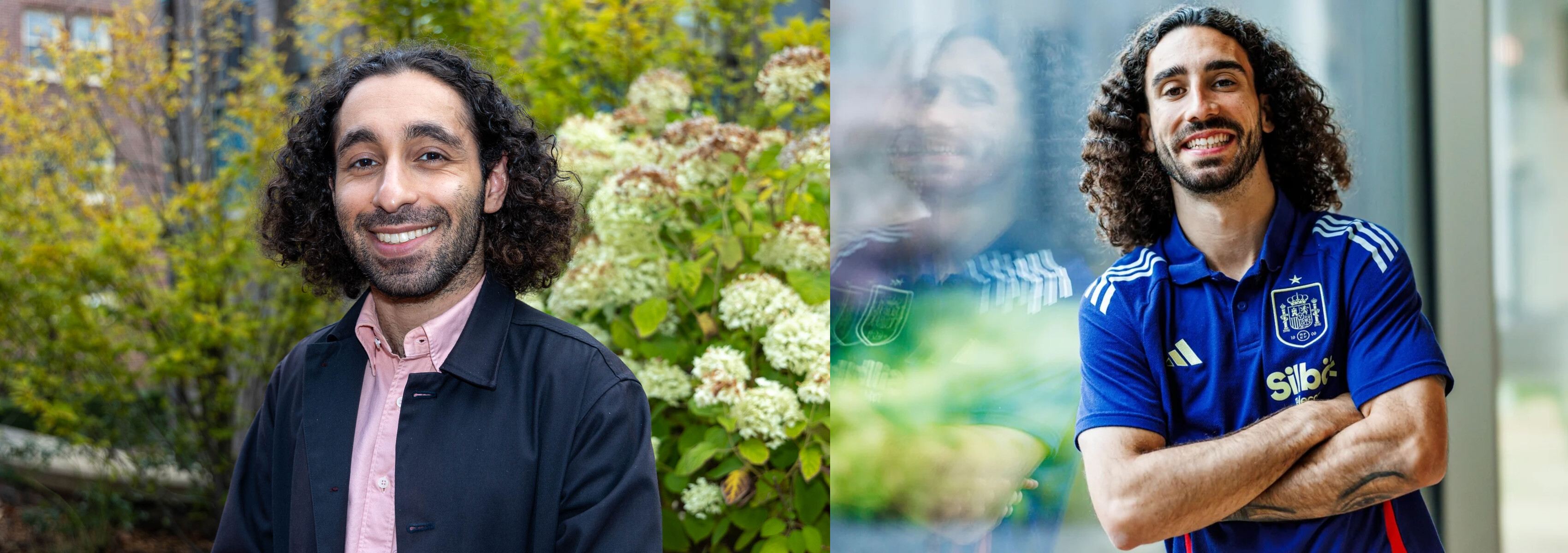 Left: A statistician who often wishes he were most anything else—why not a footballer?
Right: A footballer who has almost surely never wished he were a statistician.
In honor of Spain’s, and Mr. Cucurella’s, recent World Cup win, enjoy the viral chant composed by his fans:
Cucu-Cucurella, se come una paella
Cucu-Cucurella, se bebe una Estrella
Haaland, tiembla, que viene Cucurella
Haaland, tiembla, toma una galleta